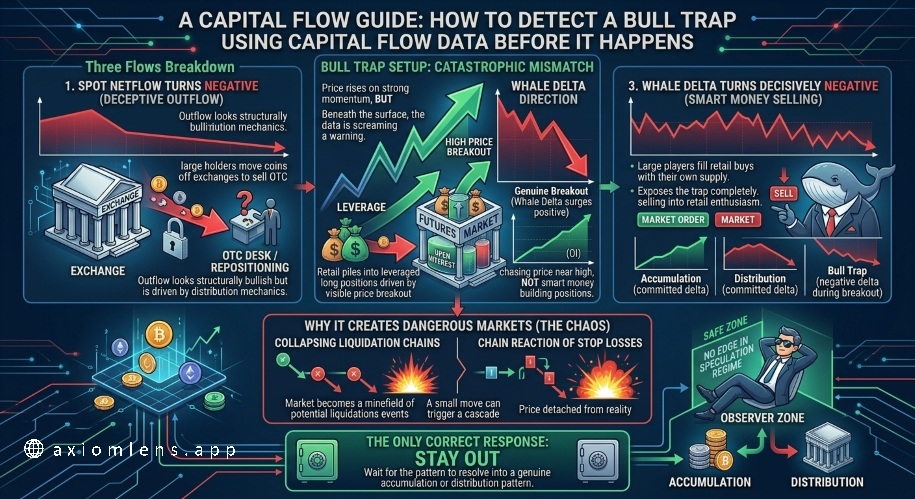
How to Detect a Bull Trap Using Capital Flow Data Before It Happens
A Bull Trap is the most costly mistake a retail trader can make near market tops. Price breaks higher, momentum looks strong, and every signal on the chart suggests continuation. But beneath the surface, the capital flow data is screaming a warning that most traders never see — because they are only looking at price.
The Bull Trap Setup in capital flow terms is not about what price is doing. It is about the catastrophic mismatch between who is buying and who is selling.
What the three flows reveal:
Spot Netflow turns negative — but deceptively so. Coins are leaving exchanges, which in isolation looks bullish. In accumulation, this signals smart money removing supply. In a Bull Trap setup, it signals something entirely different — large holders are moving coins off exchanges not to hold them, but to sell them OTC or to reposition. The outflow looks structurally bullish but is driven by distribution mechanics operating outside the visible order book.
Futures Netflow turns heavily positive. Retail is piling into leveraged long positions driven by the visible price breakout. Open interest surges as FOMO-driven buyers open positions near the high. This futures inflow is not smart money building positions — it is retail chasing price with leverage, creating the exact pool of liquidity that smart money needs to exit against.
Whale Delta turns decisively negative. This is the signal that exposes the trap completely. While retail is buying futures aggressively and spot appears to show outflow, large players are executing sell orders with market orders — filling every retail buy with their own supply. Negative whale delta during a price breakout is the single most reliable warning of a Bull Trap in formation.
The key divergence:
In a genuine breakout, whale delta surges positive alongside price. In a Bull Trap, price rises but whale delta falls. This divergence between price direction and delta direction is the fingerprint of smart money selling into retail enthusiasm. The wider the divergence, the more violent the reversal will be.
The rule:
Never enter a long position on a breakout when whale delta is negative. Price rising on negative delta is not strength — it is a transfer of risk from informed to uninformed participants. Wait for delta confirmation before committing capital.