What is Absorption Support and How Exchange Flows Reveal Hidden Demand
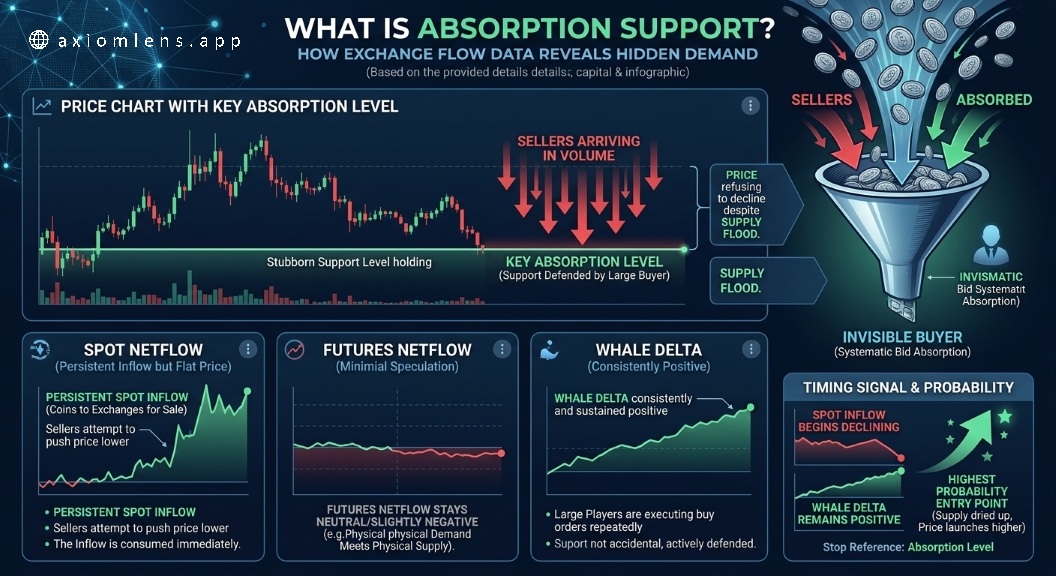
Absorption Support is the capital flow regime where the market is being held up from below by a buyer you cannot see on the price chart. Price approaches a key level, sellers arrive in volume, and yet price refuses to fall. To most observers this looks like a stubborn support level holding by chance. To a capital flow analyst it is immediately recognizable — a large buyer is systematically absorbing every unit of supply that arrives at that level.
The exchange flow data makes the invisible visible.
What the three flows reveal:
Spot Netflow turns positive — but price holds. This is the central paradox of Absorption Support. Coins are flowing into exchanges, which in any other context would be bearish. Sellers are bringing supply to market and attempting to push price lower. But price is not falling. The inflow is being met immediately by a buyer of equal or greater size who is consuming every offer without allowing price to decline. Persistent spot inflow with flat or slightly rising price is the clearest structural signal of absorption.
Futures Netflow stays neutral or slightly negative. There is no aggressive leveraged speculation happening. The battle is taking place entirely in the spot market between sellers bringing supply and a large buyer absorbing it. The absence of futures activity confirms this is not a speculative event — it is genuine physical demand meeting physical supply at a specific price level.
Whale Delta turns consistently positive. Despite the incoming sell pressure visible in spot netflow, whale delta is positive and sustained. Large players are executing buy orders repeatedly at the absorption level — not in a single spike but across multiple sessions. This sustained positive delta in the face of spot inflow is the confirmation that the support is not accidental. It is being actively defended.
Why this matters for traders:
Absorption Support creates a predictable asymmetry. The large buyer absorbing supply at that level will continue until one of two things happens — either the supply runs dry and price launches higher, or the buyer steps away and price collapses through the level. Monitoring spot netflow for signs of drying inflow is the key timing signal.
The rule:
When spot inflow begins declining while whale delta remains positive, supply is being exhausted. This is the highest probability entry point for a long position with the absorption level as the stop reference.