What is a Supply Shock in Crypto and How to Read It Through Flow Data
A Supply Shock is one of the most powerful and underappreciated setups in crypto capital flow analysis. It occurs when the available supply of an asset on exchanges drops to critically low levels while demand remains constant or grows. The result is a market where there are not enough sellers to satisfy buyers — and when a catalyst arrives, price can move violently and without warning in a very short time.
Supply Shocks do not announce themselves on the price chart. They build silently in the flow data over days and weeks before the market recognizes them.
What the three flows reveal:
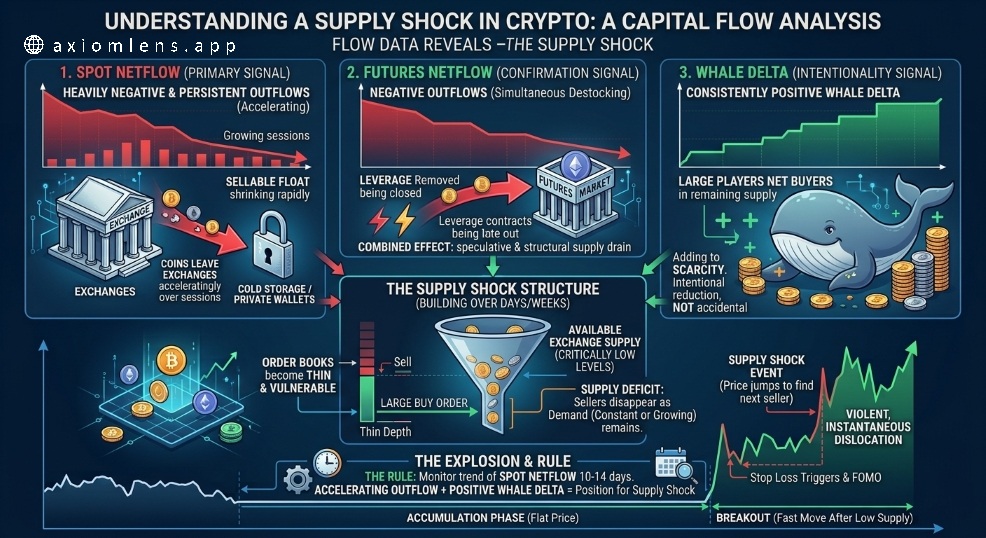
Spot Netflow turns heavily and persistently negative. This is the primary signal. Coins are leaving exchanges at an accelerating rate across multiple sessions. The sellable float — the supply available for immediate sale — is shrinking rapidly. Long-term holders and institutional players are removing assets from the market, either into cold storage or into positions they have no intention of selling at current prices. When spot outflow persists for an extended period, the exchange order books become thin and vulnerable to sudden price dislocations.
Futures Netflow also turns negative. This is the confirmation that elevates a simple spot outflow into a genuine Supply Shock signal. When both spot and futures show simultaneous outflows, the market is deleveraging and destocking at the same time. Leveraged positions are being closed while physical coins are being withdrawn. The combined effect removes both the speculative and structural supply from the market simultaneously — leaving almost nothing to absorb incoming demand.
Whale Delta turns consistently positive. While supply is draining from exchanges through both channels, large players are net buyers in whatever liquidity remains. They are not selling into the outflow — they are adding to it. Persistent positive whale delta during a dual outflow environment confirms that the supply reduction is intentional and coordinated, not accidental.
Why the explosion happens:
Markets require sellers to function. When spot supply drops far enough, a single large buy order — or an unexpected positive catalyst — encounters an order book with insufficient depth to absorb it. Price jumps to find the next available seller, triggering stop losses and FOMO simultaneously. The move is not gradual. It is instantaneous and disproportionate to the trigger.
The rule:
Monitor the trend of spot netflow over ten to fourteen days. When outflow is accelerating and whale delta is consistently positive, begin positioning for a Supply Shock event. The timing of the catalyst is unknowable — but the structural setup is readable in the data.