What is Smart Money Absence and Why It Makes Markets Dangerous
Smart Money Absence is the capital flow regime that most traders underestimate — because nothing is obviously wrong. There is no crash, no panic, no extreme reading in any indicator. The market simply feels quiet, directionless, and low energy. But this apparent calm conceals a serious structural danger that every informed trader needs to recognize and respect.
When smart money leaves the room, the market loses its primary stabilizing force. What remains is a market driven entirely by retail noise — and retail noise, by definition, has no edge and no conviction.
What the three flows reveal:
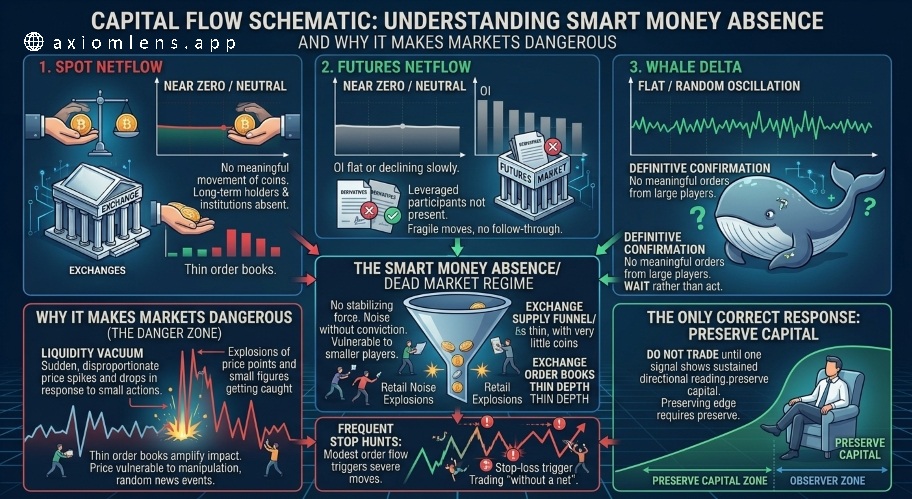
Spot Netflow stays near zero. There is no meaningful movement of coins either onto or off exchanges. Long-term holders are not acting. Institutions are not repositioning. The structural participants who normally provide directional information through their flow behavior have simply stepped away from the market entirely. The exchange order books are thin and the available supply is neither growing nor shrinking.
Futures Netflow also stays near zero. There is no meaningful new position building in the derivatives market. Open interest is flat or declining slowly. The leveraged participants who normally amplify directional moves are not present in sufficient size to create sustained momentum in either direction. Any move that does occur is fragile and easily reversed because there is no futures positioning providing follow-through.
Whale Delta stays flat and oscillates randomly around zero. This is the definitive confirmation of smart money absence. Large players are not executing meaningful buy or sell orders. The delta readings are small, inconsistent, and directionless — the behavioral signature of a market where the participants with real information and real size have chosen to wait rather than act.
Why this creates danger:
A market without smart money participation is a market without a reliable price discovery mechanism. Price becomes vulnerable to manipulation by smaller players, to random news events that would normally be absorbed without incident, and to sudden violent moves in either direction that have no flow-based foundation and therefore no predictable follow-through.
Stop hunt events become more frequent and more severe in low-liquidity environments because the thin order books amplify the impact of even modest order flow. A trader who enters a position in a Smart Money Absence regime is trading without a net — there is no large player on the same side of the trade to provide structural support.
The only correct response:
When all three flow indicators are near zero with no clear directional bias across multiple sessions, preserve capital. There is no edge available. The most profitable decision in a dead market is the decision not to trade until one of the three flow signals begins showing a sustained directional reading that indicates smart money has returned.