How to Identify Retail FOMO Through Exchange Flow Data — And Trade Against It?
Retail FOMO is the capital flow regime where the majority of market participants make the same mistake at the same time — and where informed traders find one of their most reliable contrarian opportunities. When the crowd rushes into a market driven by fear of missing out, the exchange flow data captures this behavioral pattern with remarkable precision. The signals are clear, consistent, and historically associated with price tops that range from minor corrections to major reversals.
The defining characteristic of Retail FOMO is not price direction — it is the identity of who is driving the market. And the flow data tells you exactly who that is.
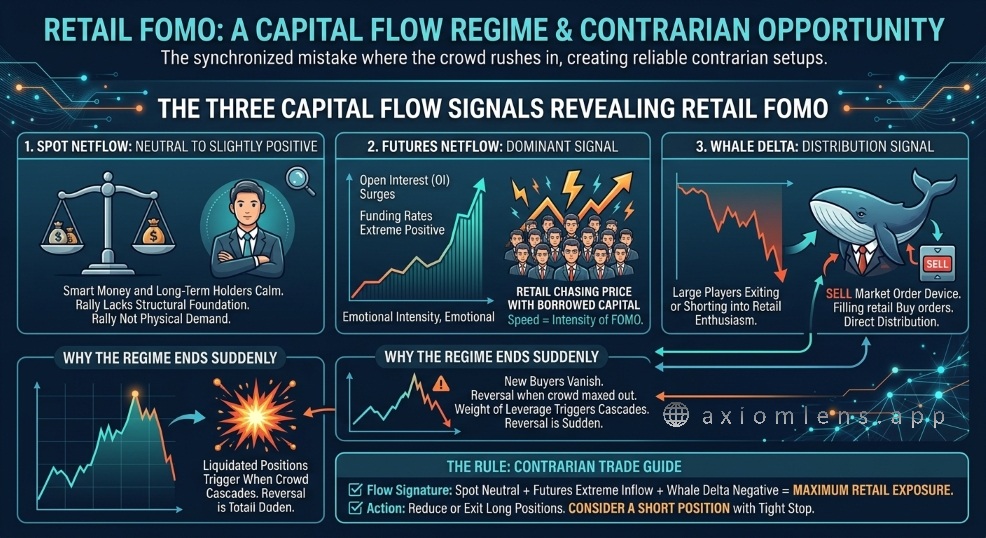
What the three flows reveal:
Spot Netflow stays neutral to slightly positive. Long-term holders and smart money are not adding to their spot positions in any meaningful way. The spot market is quiet — which means the price appreciation being observed is not driven by genuine physical demand. Real buyers with conviction accumulate in spot. The absence of spot accumulation during a price rally is itself a warning signal that the move lacks structural foundation.
Futures Netflow turns heavily and rapidly positive. This is the dominant signal of Retail FOMO. Leveraged long positions are being opened at an accelerating rate as retail participants chase price higher with borrowed capital. Open interest surges. Funding rate spikes to extreme positive levels as the long side becomes overwhelmingly crowded. The speed of the futures inflow is proportional to the emotional intensity of the FOMO — and the more extreme the reading, the more violent the eventual correction.
Whale Delta turns negative. While retail is aggressively buying futures with leverage, large players are executing sell orders against them — using the FOMO-driven demand as liquidity to exit or short their positions. Negative whale delta during a price rally driven by heavy futures inflow is one of the clearest distribution signals in capital flow analysis. Smart money is selling directly into retail enthusiasm.
The contrarian trade:
The Retail FOMO regime does not end gradually. It ends suddenly — when the last retail buyer has entered and there is no one left to push price higher. At that precise moment, the absence of new buyers combined with the weight of leveraged long positions creates the conditions for a rapid reversal. The more extreme the futures inflow and the more negative the whale delta, the faster and more severe the correction will be.
The rule:
When spot is neutral, futures inflow is extreme, and whale delta is negative — the market is at maximum retail exposure. Reduce or exit long positions. Consider a short position with a tight stop above the recent high.