What is a Panic Exit in Crypto and How to Read It Through Spot Flow Data?
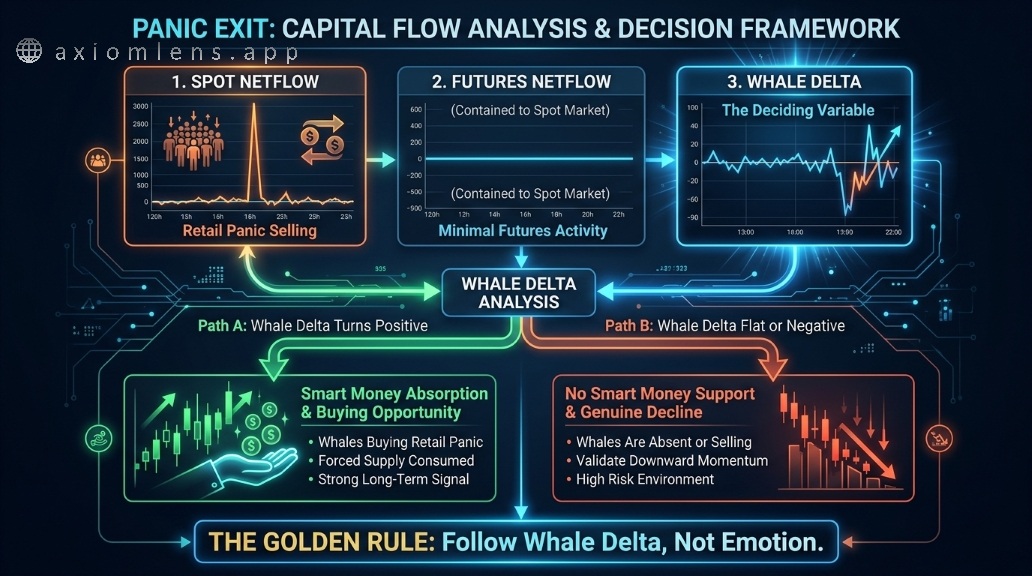
A Panic Exit is the capital flow regime where retail participants make a sudden and emotionally-driven decision to sell — not because market structure has broken down, not because smart money is distributing, but purely because fear has overwhelmed rational decision-making. It is one of the most important patterns to recognize because the correct response depends entirely on one variable: what whale delta does in response to the panic.
Panic Exit without smart money absorption is the beginning of a genuine decline. Panic Exit with smart money absorption is one of the best buying opportunities the market creates.
What the three flows reveal:
Spot Netflow spikes suddenly and sharply positive. This is the defining signal of a Panic Exit — a sudden surge of coins onto exchanges that is disproportionate to any structural change in the market. Retail holders, spooked by a sharp price move or negative news, send their assets to exchanges to sell immediately. The spike is typically sudden, large relative to recent netflow readings, and concentrated within a short window of one to three sessions.
Futures Netflow stays neutral or shows minimal activity. Unlike Capitulation where futures liquidations are a dominant force, Panic Exit is primarily a spot market event. Leveraged participants may close some positions but there is no cascading liquidation. Open interest may decline modestly but does not collapse. This containment of the panic to the spot market is a critical distinguishing feature — it means the structural damage is limited and potentially reversible quickly.
Whale Delta is the deciding variable. This is where Panic Exit diverges into two completely different outcomes. If whale delta turns positive during the spot inflow spike — large players are absorbing the panic selling with market buy orders — the Panic Exit is a buying opportunity. Supply is being consumed by informed participants and price will recover once the retail panic exhausts itself. If whale delta stays flat or turns negative — smart money is not stepping in — the Panic Exit may be the early stage of a more serious decline and caution is warranted.
The decision framework:
Monitor whale delta in real time during a spot inflow spike. Positive delta within the first session of the panic confirms absorption and signals a potential long entry. Flat or negative delta after two sessions suggests the panic is justified and positions should remain reduced until flow normalizes.
The rule:
Never react to a Panic Exit with your own panic. React to the data. Whale delta tells you whether the fear is being bought or validated. Follow the delta — not the emotion.