From Scale to Scenario: The Vital Role of Timeframes in Crypto
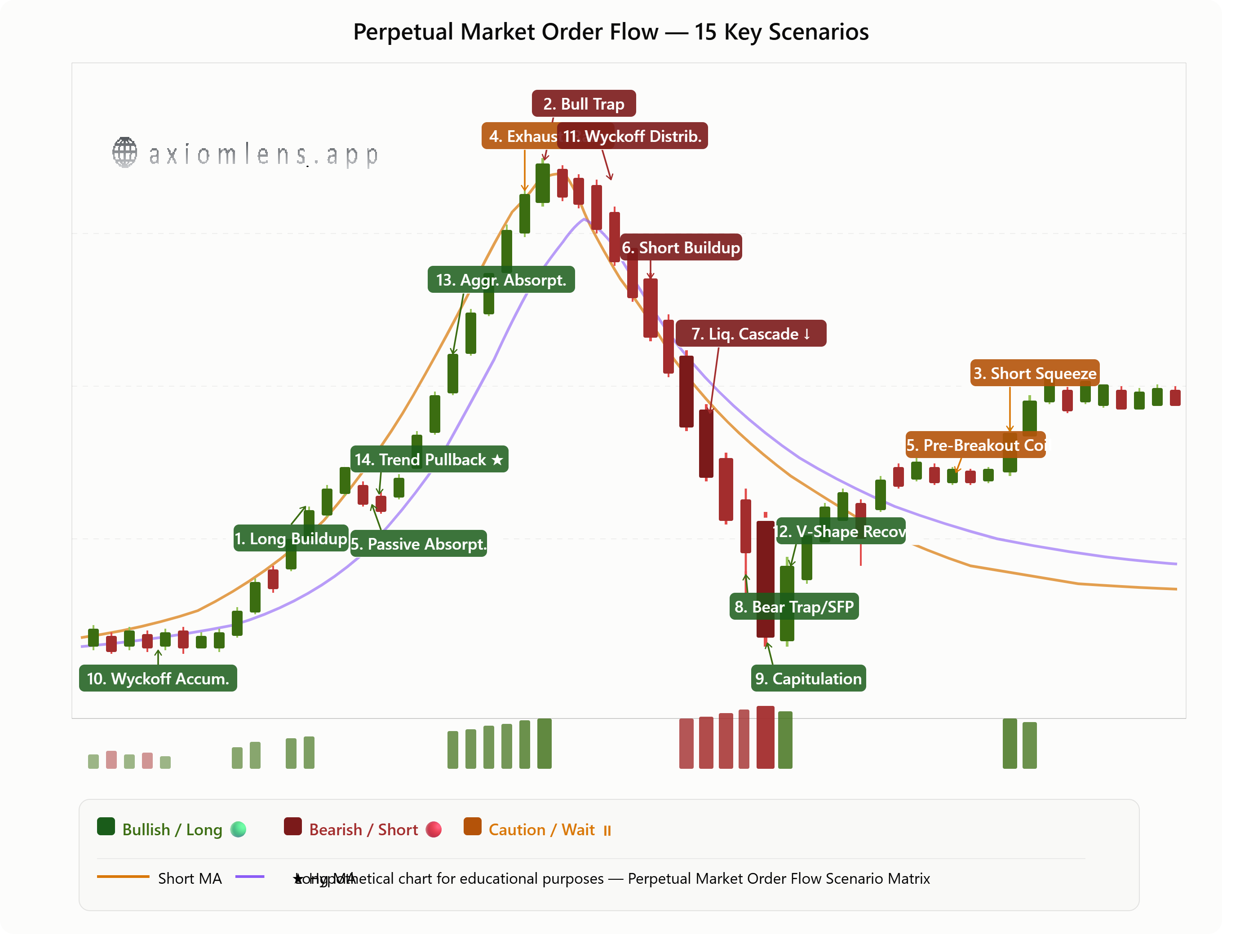
One of the most important and most overlooked principles in reading crypto markets is this: every scenario in the order flow matrix can exist simultaneously at multiple scales. A Long Buildup on the daily chart can contain a Bear Trap on the four-hour chart. A Wyckoff Distribution at the macro level can host a perfectly valid Trend Continuation Pullback at the swing level. The market is fractal — the same patterns repeat across every timeframe, and the scenario you identify depends entirely on the scale at which you are looking.
This is not a flaw in the framework. It is the framework working exactly as intended. The fifteen scenarios are not absolute descriptions of what the market is doing. They are descriptions of what the market is doing at a specific scale, for a specific duration, for a trader with a specific purpose.
____________________________________________________
Scale determines scenario — not the other way around
A position trader holding for two to three weeks and a scalper trading fifteen-minute candles can look at the same asset at the same moment and identify completely different scenarios — and both can be correct simultaneously.
Consider a concrete example. Bitcoin is in a clear macro downtrend on the weekly chart — Lower Highs, Lower Lows, negative whale delta over thirty days, consistent spot inflow. At the macro scale, a position trader correctly identifies this as Short Buildup and stays out of long positions entirely.
At the same moment, on the four-hour chart, price has just printed a sharp spike below a key support level and snapped back above it with a large positive whale delta reading. A swing trader correctly identifies this as a Bear Trap and enters a long position targeting a three-to-five day bounce back to the broken level above.
Both traders are right. Both are using the same framework. One is trading the macro trend, one is trading the micro reaction within that trend. The position trader would be wrong to ignore the macro context and chase the bounce. The swing trader would be equally wrong to ignore the short-term signal and sit on their hands because of the weekly downtrend.
____________________________________________________________
The timeframe of your trade must match the timeframe of your analysis
This is the principle that eliminates the most common trading errors. If you plan to hold a position for five to fourteen days, your scenario identification must be based on the daily chart and the five-to-fourteen day readings of your indicators — not the one-hour chart, not the monthly chart. Using a shorter timeframe to justify a longer trade, or using a longer timeframe to talk yourself out of a short-term trade, is one of the most reliable ways to make the wrong decision with the right framework.
Before every entry, answer three questions explicitly. What is my intended holding period? What timeframe does that correspond to? What scenario is dominant at that timeframe right now?
________________________________________________
The real enemy is emotion, not the market
Markets do not trap traders. Emotions trap traders. When a trader sees a large green candle and enters without identifying the scenario, the scale, or the timeframe — they are not trading. They are reacting. When a trader sees a sharp drop and panic-sells a position that was opened on a valid daily-timeframe signal — they are letting a lower-timeframe noise event override a higher-timeframe decision. Both errors share the same root cause: the absence of a structured decision-making process applied consistently at the correct scale.
The order flow scenarios and the capital flow regimes exist to replace emotional reaction with structured observation. They work at every timeframe. They work at every scale. But they only are helpful when the trader applies them at the timeframe that matches their trade — not the timeframe that matches their fear or their greed.
The market will always provide signals at every scale simultaneously. Your only job is to identify the one that belongs to you.