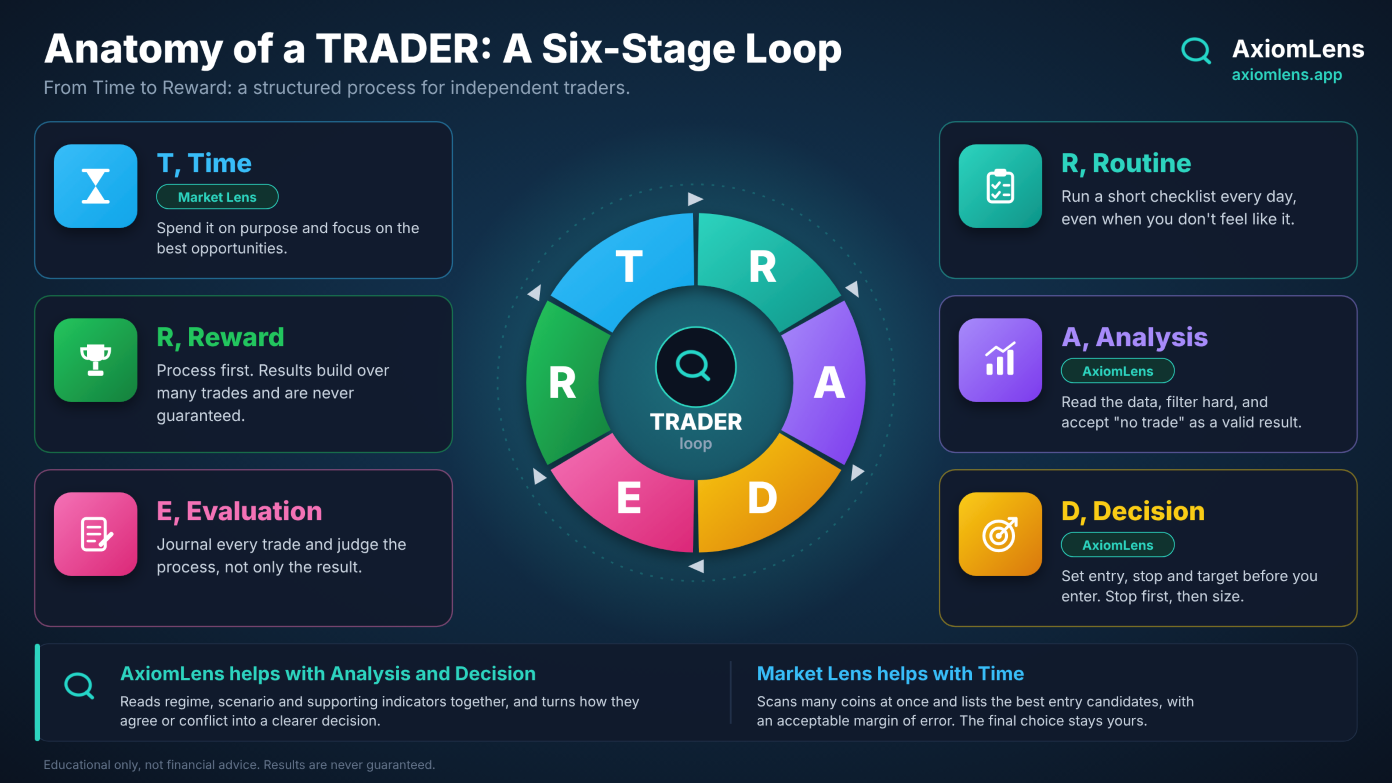
The Anatomy of a TRADER: A Step-by-Step Roadmap from Time to Reward
Many people look for the one thing that separates winning traders from everyone else: a better indicator, a better entry, a better mindset. In practice, trading is not one skill. It is a cycle with six stages. A simple way to remember them is the word TRADER:
Time → Routine → Analysis → Decision → Evaluation → Reward
Each stage feeds the next one, and the last feeds the first. If you skip a stage, the cycle breaks. Analysis without a plan leaves you hesitating. Decisions without review repeat the same mistakes. Reward without time and routine rarely lasts.
This article walks through the six stages: what each one gives you, how it usually goes wrong, and where AxiomLens helps.
T: Time. Treat It as an Asset
Time is the first thing a trader invests, and the only one you cannot get back. Treat it as a real asset and decide on purpose where it goes.
Quality beats quantity. Two focused hours with a clear task are worth more than a whole day of watching the price move.
Fit your style to the time you have. Your holding period should match your life. If you can check charts twice a day, a plan that needs constant watching will fail, and not because of your skill.
Split your time: learning, preparation, trading and review. Without a split, trading eats everything.
Fewer indicators save time. Every extra indicator is one more thing to read and doubt.
Time has an opportunity cost. Hours spent searching for one entry are hours not spent seeing other opportunities. The fix is to screen quickly and spend your deep time only on a short list of candidates. This is where a screening tool such as Market Lens helps: it scans many coins at once, so you do not have to.
This stage gives you: a protected time budget and a fast way to screen. Common failure: trading in whatever time is left over, or spending a whole day on one setup.
R: Routine. Discipline Becomes Habit
Willpower is unreliable. Habit is not. A routine means you run the same checklist every day, even when you do not feel like it.
A simple daily routine:
1. Prepare: open your charts, notes and journal.
2. Look at the big picture: market structure on a higher timeframe, and the calendar for scheduled events.
3. Review open positions: is each idea still valid? Where is it proven wrong?
4. Mark the day's levels and watchlist.
5. Write one line: what would make you act today, and what would keep you out?
A routine means fewer decisions made while emotional. When the steps are fixed, you spend less energy on "what should I do now?" and more on "what is the market doing?"
This stage gives you: a repeatable start to every session. Common failure: a routine so long that you drop it. Keep it short enough to actually do.
A: Analysis. Turn Data into Understanding
Analysis is where you read charts, mark levels and separate real opportunities from noise. Three habits help:
Work in a fixed order. In the AxiomLens framework: regime first (what money and liquidity are doing), then scenario (what pattern price is building), then ask whether the two agree. See Reading the Market with Precision.
Mark the levels that matter, including where stops and liquidity are likely to sit, because they show where an idea is proven wrong.
Filter hard. Good analysis is as much about what you reject as what you accept. "No trade" is a valid result, not a failure.
Treat indicators as clues, not proof, and look for agreement between them instead of one dramatic reading. When the layers disagree, the decision checklist tells you what to do.
This stage gives you: a short list of setups that fit your strategy, each with a reason. Common failure: analysis that never ends, or that is bent to justify a trade you already wanted.
D: Decision. Calculated Execution
A decision turns analysis into a plan with three numbers fixed before you enter: the entry, the stop-loss (SL) and the take-profit (TP). Fear and greed do the most damage when these numbers are chosen in the heat of the moment, so choose them while you are calm.
Stop first. Put the stop where the idea is proven wrong, not where the loss feels comfortable.
Then size. Position size = risk amount ÷ distance from entry to stop. Confidence changes how much you risk; the stop distance changes the size. See Position Sizing and Risk.
Check the target. Is the reward worth the risk? Use a realistic target, such as the next liquidity zone.
Choose an action: enter, enter smaller, wait or reduce. Waiting is also a decision.
This stage gives you: a written plan with entry, SL, TP, size and the condition that cancels it. Common failure: entering first and making up the stop later.
E: Evaluation. Close the Learning Loop
Most traders skip this stage, and it is the one that turns experience into improvement. Put every trade, win or lose, into a journal, and review the journal.
What to record for each trade:
The setup and why you took it (regime, scenario, how the indicators lined up).
Entry, stop, target, size and the risk you took.
What happened, and whether you followed your own plan.
How you felt at entry and at exit.
Review on a schedule, for example once a week, and sort mistakes into four types: analysis (misread the market), decision (bad plan or size), execution (did not follow the plan) and emotion (fear or greed took over). Change one thing at a time so you can tell whether it helped.
The key idea is to judge the process, not only the result. A trade that followed the plan and lost can still be a good trade. A trade that broke the plan and won is a warning, not a success. Using the same labels each time (regime, scenario, intensity) makes your entries easy to compare from week to week.
This stage gives you: one or two clear changes for next week. Common failure: a journal of results with no review.
R: Reward. The Harvest, Honestly Defined
Reward comes last because it is a result, not an action. It needs an honest definition. Profit is part of it, but no process guarantees profit, and the market can punish good decisions in any given month. A more reliable way to see reward is in layers:
1. Process reward: you followed your routine and plan, and kept your risk inside your limits.
2. Skill reward: your journal shows fewer repeated mistakes over time.
3. Mental reward: calmer decisions, less fear, less impulse.
4. Financial reward: results that build over many trades, not from any single one.
5. Time reward: a process that fits your life and leaves you free time.
Check the first three before you judge the fourth. Reward then flows back into the first stage: protected capital and a working process buy you more time to learn and prepare.
The Cycle at a Glance
Stage: Time
The question it answers: How much focused time do I have, and how do I use it well?
What it gives you: A protected time budget and a fast screening method
Common failure: Trading in leftover time, or spending a day on one setup
Stage: Routine
The question it answers: What do I do every day, no matter what?
What it gives you: A short, repeatable start
Common failure: A routine too long to keep
Stage: Analysis
The question it answers: What is the market doing, and which setups fit?
What it gives you: A filtered list of setups
Common failure: Endless or biased analysis
Stage: Decision
The question it answers: Entry, stop, target, size, or no trade?
What it gives you: A written plan
Common failure: Making up the stop later
Stage: Evaluation
The question it answers: What did I learn, and what changes?
What it gives you: One or two clear changes
Common failure: Results without review
Stage: Reward
The question it answers: Is the process paying off, honestly?
What it gives you: Confidence and capital to continue
Common failure: Judging by one result
Where AxiomLens Fits
AxiomLens is built to help most with two of these stages.
Analysis: it reads the capital-flow regime, the order-flow scenario and the supporting indicators together, so you do not have to reconcile many charts by hand.
Decision: it helps you turn how those layers agree or conflict into a clearer choice, with the stop and size logic in the same framework.
Market Lens, the new product from AxiomLens, also helps with Time. Among a large number of coins, it quickly lists the best candidates for entry, with an acceptable margin of error, so you can spend your time on the most promising ones. It narrows the field; the final choice is still yours, through your own checklist.
Common Mistakes
Skipping the routine on "quiet" days. Habit lives on the days you do not feel like it.
Analysis without a decision plan. Seeing a setup is not the same as knowing your entry, stop and size.
No journal, or a journal of results only. Without reasons and feelings, there is nothing to learn from.
Judging a trade by its result. Judge it by whether you followed the process.
Confusing a wide scan with more trades. Seeing more opportunities means more choices, not more trades. Pick only the best.
Expecting reward on a fixed schedule. Profit comes in streaks. The process is what you control.
Adding stages instead of fixing one. If the cycle is breaking, find the weakest stage first.
Takeaway
TRADER = Time, Routine, Analysis, Decision, Evaluation, Reward: a cycle, not a single skill.
Treat time as an asset. Fit your style to the hours you have, and screen quickly so you spend deep time only on the best candidates.
A short daily routine means fewer emotional decisions.
Analyze in a fixed order, and accept "no trade" as a valid result.
Decide entry, stop, target and size before you enter.
Judge the process, not only the result, and change one thing at a time.
Define reward honestly: process first, then skill and mindset, then profit over many trades.
O. H.
Founder, AxiomLens
This article is part of the AxiomLens educational series and is for education only, not financial advice.